Three Firewire Surfboards Walk Into a Lineup: Neutrino, Revo Max, and Machadocado Reviewed for 2026
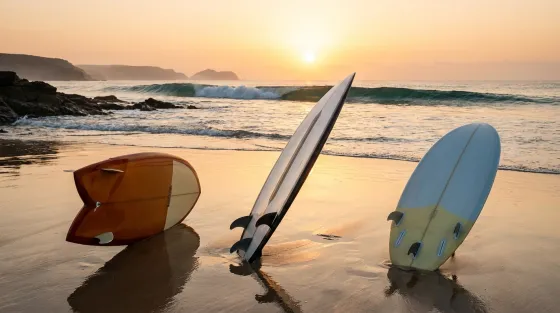
Firewire has spent years positioning itself as the brand that makes other surfboard manufacturers slightly nervous. While much of the industry still debates whether to move beyond traditional PU/polyester construction, Firewire is out here building boards with volcanic basalt fibres and parabolic carbon strips like it is engineering Formula 1 cars for the ocean.
For 2026, three boards in particular have generated serious buzz: the Tomo-designed Neutrino, the wave-hungry Revo Max, and Rob Machado's gloriously named Machadocado. Here is what makes each one tick, and whether any of them are worth the not-insignificant asking price for UK surfers eyeing up their next quiver addition.
The Neutrino: Tomo's Small-Wave Science Project
Daniel 'Tomo' Thomson has made a career out of designing surfboards that look like they fell out of a geometry textbook, and the Neutrino is no exception. This is essentially a modernised evolution of his Nano design from around 2008/2009, which means it has had roughly 17 years of refinement. That is longer than most of us have stuck with any hobby.
The headline feature is Firewire's I-Bolic 2.0 construction. This is not marketing fluff. It is a genuinely sophisticated build using a 1.5lb EPS core, an 18mm high-density foam stringer, 16mm parabolic rails, and a carbon strip inlay on the bottom deck. The result is a board that is light, responsive, and built to generate speed in conditions where most boards would leave you doing the paddle of shame back to the car park.
The bottom contour uses what Firewire calls a 'quad inside single concave' design, which channels water in a way that creates lift and speed through flat sections. Paired with that distinctive wide, square tail - described as one of the lowest-drag tail designs available - the Neutrino is essentially an exercise in making mediocre waves feel considerably less mediocre. For anyone surfing the British coastline nine months of the year, that is a genuinely useful superpower.
Sizing is where things get interesting, and potentially problematic. The Neutrino comes in nine sizes ranging from 5'3" (25.5L) to 6'2" (44.0L), priced between $995 and $1,125 USD from the US store. Multiple sources flag that oversizing this board kills its intended performance feel entirely. If you are tempted to go bigger 'just in case,' resist the urge. Tomo designed the volume and dimensions with purpose, and second-guessing him rarely ends well.
The board currently holds a perfect 5.0/5 stars on Firewire's website, though with only three reviews, that is more of a promising start than a definitive verdict.
The Revo Max: When You Need a Board That Will Not Flinch
Where the Neutrino thrives in smaller surf, the Revo Max is built for days when the ocean means business. Also designed by Tomo, this is a twin-fin step-up midlength rated for conditions from waist-high to triple overhead - that is roughly 2 to 8 feet for those who prefer numbers to vague body-part references.
The construction here is particularly noteworthy. The Revo Max uses Firewire's Volcanic lamination, which incorporates basalt fibres derived from actual volcanic rock. It is positioned as an eco-friendlier alternative to carbon fibre, which is a nice thing to care about when you are riding a sport that depends entirely on a healthy ocean. The bottom features a Vee Quad Concave contour designed to handle the increased speed and power that comes with larger waves without the board getting twitchy underneath you.
Available in five sizes from 6'0" (31.3L) to 7'0" (53.5L), the Revo Max commands $1,125 to $1,255 USD, making it the priciest of the three. For UK buyers factoring in shipping and local markup through stockists like Boardshop.co.uk, you are looking at a serious investment. But for a board that can handle overhead-plus conditions with genuine composure, it is competing against custom step-ups that often cost similar money without the construction consistency.
With a 4.9/5 rating across 13 reviews on Firewire's site, the Revo Max has the most established feedback of this trio, and the consensus is overwhelmingly positive. If you are planning a surf trip somewhere with actual waves (read: not Bournemouth in February), this is the one to have in the bag.
The Machadocado: Yes, That Is Really Its Name
Rob Machado has always surfed like he is hearing music nobody else can, and the Machadocado reflects that creative sensibility - right down to its wonderfully absurd name. Firewire's official description calls it 'the outline of an avocado mixed with the DNA of a fish and the performance of a shortboard,' which sounds like something you would order at a very confused restaurant but actually makes sense once you see it in the water.
Built with Firewire's Helium Core construction - featuring a stringerless EPS core with Paulownia and Balsa wood rails - the Machadocado is designed to be light, lively, and ridiculously versatile. It supports twin, twin-plus-trailer, and thruster fin setups, which essentially gives you three different boards for the price of one. That is the kind of value proposition that even the most budget-conscious surfer can appreciate, especially when that one board costs nearly a grand.
The size range is the most generous of the three: twelve sizes from 5'2" (25.9L) to 6'2" (47.1L), priced between $995 and $1,125 USD. Surf n Show's detailed review gave it strong marks for speed (4.5/5) and flex and feel (4.5/5), with slightly more modest scores for flow (3/5) and rail-to-rail transitions (3/5). That is a fair trade-off for a board that is trying to do many things competently rather than one thing perfectly. Think of it as the Swiss Army knife of the Firewire range, only considerably more fun at the beach.
The Verdict: Which One Deserves Your Hard-Earned Cash?
All three boards sit firmly in the premium bracket. UK surfers should expect to pay a fair bit more than the listed USD prices once shipping, import duty, and local markup are factored in. Stockists like Boardshop.co.uk carry Firewire boards domestically, which saves the headache of importing directly and dealing with customs.
So, which one? If your local break serves up mostly knee-to-chest-high waves (welcome to Britain, grab a wetsuit), the Neutrino is probably your best bet. Its small-wave performance engineering is genuinely impressive, and Tomo's I-Bolic 2.0 construction squeezes speed from conditions that would leave lesser boards wallowing.
If you are regularly scoring overhead-plus conditions or want a travel board that will not embarrass you when the swell picks up, the Revo Max earns its higher price tag. The Volcanic construction is a genuine talking point, and the wave range is remarkably broad for a single board.
And if you want one board that adapts to whatever the ocean throws at you - and you enjoy the simple pleasure of swapping fin setups like a surfer who has their life together - the Machadocado's versatility makes it a genuinely clever purchase. Three fin configurations in one board is hard to argue against when you are watching your pennies.
Firewire is not cheap. But then again, neither is the petrol to drive to the coast, the wetsuit that keeps you alive in March, or the post-surf pasty that makes it all worthwhile. At least the board will not need filling up.
Read the original article at source.





No comments yet. Be the first to share your thoughts.