Snow in Tenerife? Storm Therese Forgot the Canary Islands Are Supposed to Be Sunny
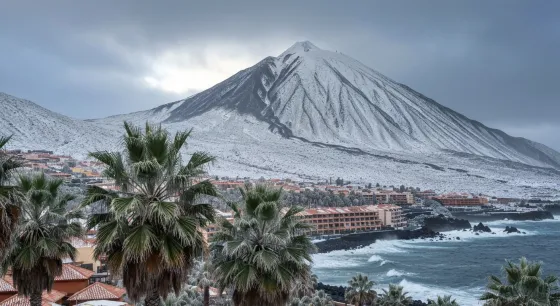
Snow on a sun-soaked volcanic island. Storm Therese clearly did not get the memo about Tenerife being one of Europe's favourite beach holiday destinations.
Starting from 18 March 2026, the storm barrelled into the Canary Islands with all the subtlety of a toddler at a dinner party, bringing snow, ferocious winds, and enough rain to make even the most stoic British tourist reconsider their "it never rains in Tenerife" assumptions. Authorities swiftly activated emergency plans, closing roads and cancelling events as weather warnings blanketed the archipelago.
For an island chain that typically sells itself on eternal spring, this was quite the brand departure.
The Numbers That Matter
Let us get into the figures, because Storm Therese brought serious firepower. Wind gusts reached 90 to 100 km/h (56 to 62 mph in old money). Rainfall hit up to 100mm in just 12 hours across southern Tenerife, with Gran Canaria recording around 80mm in the same window. Over multiple days, parts of La Palma and Tenerife were forecast to receive a staggering 300mm or more of total rainfall.
And then there is the snow. Yes, actual snow. On Tenerife. Approximately 2cm of the white stuff settled above 1,800 to 1,900 metres on Mount Teide, which at 3,718 metres (12,200 feet) stands as Spain's tallest peak. For an island where most visitors pack nothing heavier than factor 50 and a pair of flip-flops, this qualified as a genuine plot twist.
Mount Teide: Closed for Business
Teide National Park was promptly shut above 1,800 metres due to snow and ice. This seems entirely reasonable when you consider that the average visitor is probably wearing trainers and a light cardigan rather than crampons and a down jacket.
The road TF-445 leading to Punta de Teno was also closed, and the authorities were not in the mood for half-measures.
Spain's meteorological agency AEMET issued orange weather warnings across the archipelago, with the specifics varying island by island. Gran Canaria picked up an orange rain alert. La Palma and Tenerife received orange wind warnings. El Hierro and western La Palma were handed orange coastal alerts as waves surged to a genuinely alarming 5 to 6 metres. Force 8 winds howled between Tenerife and Gran Canaria, driving waves to similar heights. If you had a leisurely inter-island ferry crossing booked, you were in for a deeply unpleasant afternoon.
Flights Grounded, Tourists Stranded
Flights were cancelled across the Canary Islands, leaving thousands of travellers well and truly stuck. No specific airlines or flight numbers have been widely confirmed, but the scale of the disruption was significant enough to dominate European travel headlines for days.
For anyone who had smugly booked a March getaway to dodge the British drizzle, Storm Therese delivered a particularly generous serving of cosmic irony. "Escape the rain," the travel brochures said. "Guaranteed sunshine," they promised. Right.
The Island Emergency Plan (known locally as PEIN) was activated for Tenerife. Events were scrapped, roads blocked off, and the overriding message from local authorities boiled down to one simple instruction: stay indoors and wait it out. Not exactly the holiday itinerary most people had paid for.
Schools Shut Across the Islands
By 20 March, regional authorities officially suspended classes across the Canary Islands. While school-age children presumably greeted this news with the same unbridled joy they reserve for surprise snow days back home in the UK, the reasoning behind the decision was anything but cheerful. Conditions had simply made journeys to and from schools too dangerous to risk, and officials were not willing to gamble on it.
Remco Evenepoel's Unexpected Detour
In a wonderfully bizarre subplot, Belgian professional cyclist Remco Evenepoel reportedly found himself stranded on Mount Teide during a training session when the snow descended without warning. The incident threw his participation in the upcoming Volta a Catalunya into serious doubt.
There is something almost comically perfect about one of the world's premier athletes being stopped dead in his tracks by 2cm of snow on a subtropical volcanic island. You can practically hear the Benny Hill theme playing in the background.
Second Time Lucky for Teide's Snow
Here is the detail that really raises eyebrows: this was not even the first time Teide saw significant snow in March 2026. An earlier storm, Regina, had already blanketed the summit on 3 March, making Therese the second major snowfall event inside three weeks.
One social media vlogger, known as "The Knightstrider," captured footage alongside a telling observation: "Snow up Teide again. We had barely any last year, plenty this year!"
Whether this pattern signals something meaningful about shifting weather or simply marks a particularly dramatic month remains a question best left to the meteorologists. But two notable snow events on a Canary Island within 20 days is, at the very minimum, worth paying close attention to.
The Storm Spreads to Mainland Spain
Storm Therese was not content to confine its mischief to the islands. By 20 March, the system had pushed into mainland Spain, bringing miserable conditions to Extremadura, Madrid, Castilla-La Mancha, and sections of the Mediterranean coast. Weather warnings were expected to remain in force until at least Sunday 22 March, with lingering showers forecast well into the first half of the following week.
Some reports suggested coastal temperatures in Tenerife plummeted from the mid-20s to around 13 degrees Celsius, though this particular figure has not been independently verified across multiple sources. Similarly, unverified reports mentioned Saharan dust (locally known as Calima) accompanying the storm and creating an orange haze. Both claims should be treated with a degree of caution until properly corroborated.
What Travellers Should Know
If you have a Canary Islands trip on the books for the coming weeks, do not panic. Storms like Therese are disruptive but temporary, and the islands' infrastructure is well equipped to handle severe weather when it arrives. That said, keeping a close eye on AEMET forecasts and your airline's live status updates before heading to the airport is strongly advised.
Travel insurance remains, as always, your absolute best friend in situations like these. If you have not already got a decent policy sorted, consider this your nudge. And perhaps throw a jumper into the suitcase alongside the swimwear. Just in case Tenerife decides to channel its inner Peak District once more.
The Bigger Picture
Storm Therese served as a sharp reminder that even the sunniest destinations on the planet are not immune to extreme weather. Snow on Tenerife makes for arresting headlines and surreal photographs, but behind the novelty lies real disruption: cancelled flights, shuttered schools, stranded tourists, and emergency services working flat out to keep everyone safe.
The Canary Islands will bounce back quickly, as they always do. The sun will return, the flights will resume, and the poolside cocktails will flow once more. But for those caught in the thick of it, March 2026 will be fondly remembered as the month Tenerife briefly and spectacularly forgot it was supposed to be paradise.
Read the original article at source.





No comments yet. Be the first to share your thoughts.