The Super Bowl of AI, Tesla's Trust Problem, and Meta's 24-Hour U-Turn on the Metaverse
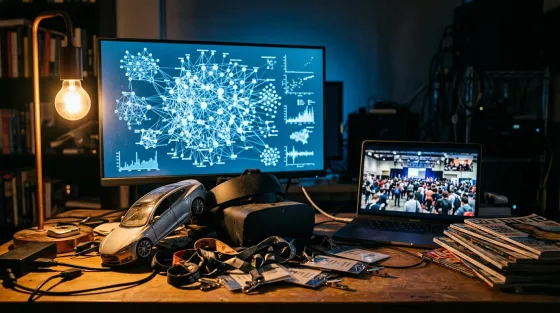
What a week in tech. Nvidia threw the party of the year, Tesla managed to annoy its most loyal fans, and Meta announced the death of its VR metaverse only to resurrect it faster than you can say "sunk cost fallacy." Let's unpack the lot.
Nvidia's GTC 2026: Where Leather Jackets Meet Trillion-Dollar Forecasts
Every year, Nvidia's GTC conference gets a little bigger, a little louder, and a little more like a tech religion's annual pilgrimage. This year's edition in San Jose has been dubbed the "Super Bowl of AI" (a title also claimed by GTC 2025, because apparently one Super Bowl a year isn't enough for Jensen Huang). Nearly 20,000 people packed into the SAP Center for the keynote alone, with the broader event drawing 39,000 attendees from 190 countries, 450 sponsors, and 2,000 speakers. That's less a developer conference and more a small city.
The headline announcement? The Vera Rubin platform, Nvidia's next-generation AI chip architecture and successor to Blackwell. The Vera Rubin NVL72 pairs 72 Rubin GPUs with 36 Vera CPUs, and for those who fancy something even beefier, the Vera Rubin Ultra can stitch together up to 144 GPUs. If that sounds like overkill, you clearly haven't met the AI industry's appetite for compute.
Huang also revealed the Groq 3 Language Processing Unit, born from Nvidia's roughly $20 billion acquisition of Groq back in December 2025. That deal was Nvidia's largest ever, and the Groq 3 represents a serious bet on specialised inference hardware. Add in the announcement of DLSS 5 for gamers and the Kyber rack architecture (144 GPUs, shipping 2027), and you've got a company firing on every cylinder it can find.
Then came the number that made the room gasp: Nvidia now forecasts $1 trillion in AI chip purchase orders for Blackwell and Vera Rubin through 2027. That's double the previous $500 billion forecast through 2026. For a company with a market cap hovering around $4 trillion, Huang clearly isn't short on confidence. Whether the rest of the world's data centres can actually absorb that much silicon remains the trillion-dollar question.
For UK readers, this matters more than you might think. Nvidia's supply chain and pricing directly influence what British businesses and research institutions pay for AI infrastructure. When Jensen sets the price, we all feel it.
On the automotive front, Nvidia announced its RoboTaxi Ready platform with partnerships including BYD, Hyundai, Nissan, and Geely. Seven manufacturers producing roughly 18 million vehicles per year are now on board. The company also dropped a cool $2 billion investment into AI cloud firm Nebius and backed former OpenAI CTO Mira Murati's new venture, Thinking Machines. Jensen Huang, it seems, is hedging every bet on the table simultaneously.
Tesla's FSD Fiasco: How to Lose Friends and Alienate Influencers
Meanwhile, over in Tesla land, things are decidedly less triumphant. The company managed to pull off something genuinely impressive: making its most devoted fans feel betrayed.
The controversy centres on Tesla's Full Self-Driving (FSD) transfer policy. Tesla had previously told customers they could transfer their FSD licence to a new vehicle if they placed an order by 31 March. Straightforward enough, right? Except Tesla quietly changed the terms to require customers to take delivery by 31 March, without telling anyone. For Cybertruck buyers stuck in long delivery queues, this was effectively a trap.
Accusations of a "bait and switch" spread quickly. Influencer Sawyer Merritt's thread on X about the policy change racked up over 700,000 views. For context, FSD was once available as a one-off purchase for up to $15,000. It's now subscription-only, which already rubbed long-time owners the wrong way. This latest move poured petrol on an already smouldering fire.
But the FSD transfer debacle is just one symptom of a broader exodus. Wired recently profiled Tesla influencers publicly walking away from the brand, including Jilianne, who had produced over 170 hours of FSD demonstration content on X to her 16,000 followers. The reasons go beyond policy gripes: Elon Musk's increasingly polarising political involvement and years of unfulfilled FSD promises have worn thin even the most patient advocates.
There's something almost poetic about a company whose CEO promised fully autonomous robotaxis "next year" every year since 2016, now losing its most enthusiastic cheerleaders over a delivery deadline technicality. It's the little betrayals that sting the most.
Meta's Metaverse: Dead, Then Alive, Then... Expensive
And finally, the week's most entertaining plot twist. On 17 March, Meta announced it would shut down Horizon Worlds VR by 15 June 2026. Quest Store listings would be pulled by the end of March. The metaverse, or at least Meta's particular vision of it, was officially on life support.
The reasoning was telling. Horizon Worlds mobile app downloads were up 53% year-on-year, which Meta apparently interpreted as permission to abandon the VR users who had actually believed in the platform from the start. The VR version never attracted more than a few hundred thousand monthly active users, which is roughly the population of Sunderland. Not exactly the billion-user metaverse Zuckerberg once promised.
Then came the backlash. Fans described themselves as "heartbroken." Within 24 hours, CTO Andrew Bosworth hopped onto Instagram Stories (of all places) to announce that Meta would keep Horizon Worlds in VR "for the foreseeable future." A full reversal in under a day. One has to wonder whether anyone at Meta HQ thought to gauge community reaction before making the announcement.
The financial backdrop makes the whole saga even more absurd. Meta's Reality Labs division has lost a staggering $73 billion since 2021, with $19.2 billion of that vanishing in 2025 alone. The most recent quarter saw $6.02 billion in losses against just $955 million in revenue. Weeks before the Horizon Worlds announcement, Meta cut over 1,000 employees from Reality Labs.
Zuckerberg has said 2026 losses will likely be similar to 2025's, but insists this year will "likely be the peak." We've heard versions of that optimism before. At $73 billion and counting, "peak losses" is the sort of phrase that should come with a health warning.
The Bigger Picture
What connects these three stories is a tech industry grappling with the gap between ambition and execution. Nvidia is selling a future where AI compute demand is essentially infinite, and right now, the market believes them. Tesla is discovering that customer loyalty has limits, even in a fanbase that once bordered on the devotional. And Meta is learning the hard way that you can't spend $73 billion building a metaverse, then casually bin it without people noticing.
For those of us watching from the UK, the practical takeaway is this: AI infrastructure costs are going up, electric vehicle brand trust is going down, and the metaverse remains the most expensive experiment in tech history with precious little to show for it. At least it's never boring.
Read the original article at source.





No comments yet. Be the first to share your thoughts.