Palantir's AIPCon 9: Where Silicon Valley Meets the Battlefield, and Business Is Booming
War Is Good for Business, Apparently
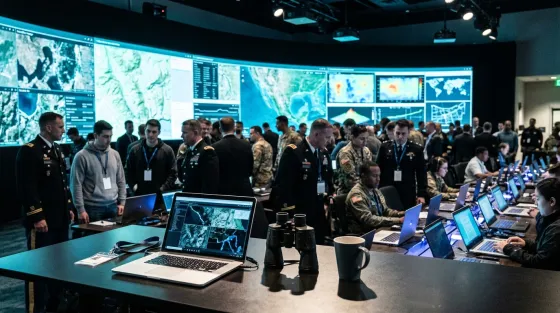
If you ever wondered what happens when a tech conference collides with an active military campaign, Palantir's AIPCon 9 provided a rather unsettling answer. Held on 12-13 March 2026 in Maryland, the developer conference showcased AI systems designed not to recommend your next Netflix binge, but to identify targets and assign munitions in real-time warfare.
And the timing? Absolutely deliberate, one suspects. The conference took place whilst US forces were actively conducting Operation Epic Fury against Iran, an operation that struck 1,000 targets in its first 24 hours after launching on 28 February 2026. That is, by some analysts' estimates, roughly twice the air power unleashed during the 2003 Iraq 'shock and awe' campaign, delivered in a fraction of the time.
Maven Gets Its Moment in the Spotlight
The centrepiece of AIPCon 9 was a live demonstration of the Maven Smart System by Cameron Stanley, the Department of Defense's Chief Digital and AI Officer. For those unfamiliar, Project Maven has been quietly evolving since 2016, originally partnered with Google until employee protests forced the tech giant to walk away in 2018. Palantir was more than happy to pick up where Google left off.
What Stanley demonstrated was genuinely remarkable from a technical standpoint, even if the implications make your stomach turn a bit. The Maven system consolidates what were previously eight or nine separate targeting systems into a single interface. Stanley himself noted: 'We were having this done in about eight or nine systems where humans were literally moving detections left and right.'
The demo showed satellite imagery being processed in real time, with the system distinguishing people from vehicles and then proposing munitions assignments through what Palantir calls its AI Asset Tasking Recommender. Think of it as autocomplete, but for airstrikes.
From 2,000 Intelligence Officers to 20
Perhaps the most striking statistic came from Chad Wahlquist, a Palantir architect, who claimed that targeting tasks which required roughly 2,000 intelligence officers during Operation Iraqi Freedom could now be handled by approximately 20 people using the Maven system. That is a 99% reduction in human involvement in the targeting chain. Whether you find that impressive or terrifying probably depends on your perspective, but it is worth sitting with both reactions for a moment.
Alex Karp: Silicon Valley's Most Unapologetic Defence CEO
Palantir CEO Alex Karp, never one to shy away from a bold statement, was in characteristically forthright form. 'What makes America special right now is our lethal capabilities, our ability to fight war,' he told CNBC on the conference's opening day. He went further, describing the AI revolution as 'uniquely American' and adding: 'Once the war starts, we're not interested in debating how we're supporting them.'
It is the sort of rhetoric that would make most tech CEOs' PR teams break out in a cold sweat. But Karp has built a company now valued at approximately $365 billion (with shares trading around $152.77 as of mid-March 2026) precisely by leaning into the uncomfortable space where Silicon Valley meets the Pentagon.
The Anthropic Paradox
One of the more fascinating subplots involves Anthropic, the AI safety company behind the Claude language model. Here is where it gets properly tangled: Maven uses Anthropic's Claude AI model as part of its targeting stack. Karp confirmed as much, stating: 'It's our stack that runs the LLMs.'
The problem? Anthropic and the Pentagon are currently at each other's throats. Anthropic CEO Dario Amodei published blog posts asserting that the DoD refused to implement safeguards against domestic mass surveillance and autonomous weapons use. In response, Defence Secretary Pete Hegseth designated Anthropic a 'supply-chain risk.' Anthropic then sued the Pentagon.
Despite this rather spectacular falling-out, Karp confirmed Palantir continues using Claude regardless. So we have an AI safety company's technology being used in a military targeting system, whilst that same company is suing the military over safety concerns. You genuinely could not make this up.
The Elephant in the Room
Any honest account of AIPCon 9 must acknowledge what was happening in the background. A Pentagon investigation was underway into a strike on the Shajareh Tayyebeh primary school in Minab, Iran, which killed more than 160 people, mostly schoolgirls aged 7-12. Sources cited by Semafor indicated that human intelligence analysts, not the AI system, were blamed for the targeting failure. But the fact that this investigation was running concurrently with a conference celebrating the very systems involved in the campaign cast an unavoidable shadow over proceedings.
Karp, for his part, insisted there was 'never a sense' that AI products would be used for domestic surveillance. That may be true, but the question of how AI-assisted targeting handles civilian risk in foreign operations is arguably the more pressing concern right now.
What This Means for the Tech Industry
Palantir's trajectory tells us something significant about where the technology sector is heading. The company that was once considered too controversial for mainstream investors is now one of the most valuable firms on the planet. Defence contracts are no longer something tech companies hide behind vague language about 'government services.' They are the product.
The conference also showcased ShipOS, Palantir's naval system, and signalled plans to integrate additional AI models beyond Claude going forward. The message was clear: this is not a company hedging its bets. This is a company that has decided the future of AI is military, and it is building accordingly.
The Broader Questions
- Accountability: When an AI system recommends a target and the strike kills civilians, where does responsibility sit? With the 20 remaining operators? The algorithm? The company that built it?
- Speed vs safety: Reducing targeting from thousands of analysts to dozens dramatically increases speed. But speed in warfare is not always a virtue.
- The ethics gap: Google walked away from Maven in 2018. Palantir walked towards it. The market rewarded Palantir handsomely. What does that tell us about the industry's moral compass?
The Verdict
AIPCon 9 was not just a developer conference. It was a statement of intent from a company that has decided the most profitable application of artificial intelligence is not chatbots or image generators, but the machinery of war. With a $365 billion valuation and an active military campaign serving as a live demonstration, Palantir is proving that bet correct, at least financially.
Whether the rest of us should be comfortable with that is another question entirely. The technology is genuinely impressive. The reduction in personnel, the consolidation of systems, the speed of targeting. But impressive technology without robust ethical guardrails is not progress. It is just capability.
And capability, as the families in Minab can attest, is not the same thing as wisdom.
Read the original article at source.





No comments yet. Be the first to share your thoughts.