China Just Approved the World's First Commercial Brain Chip, and It's Not Messing About
The BCI Race Just Got Real
While Elon Musk's Neuralink has been hogging headlines with flashy demos and promises of a sci-fi future, China has quietly done something no other country has managed: actually approved a brain-computer interface for commercial sale.
On approximately 13 March 2026, China's National Medical Products Administration (NMPA) gave the green light to Neuracle Medical Technology's NEO implant, making it the first invasive brain-computer interface (BCI) to receive commercial marketing approval anywhere on the planet. Not in a lab. Not in a trial. For actual, real-world clinical use.
Let that sink in for a moment.
What Exactly Is NEO?
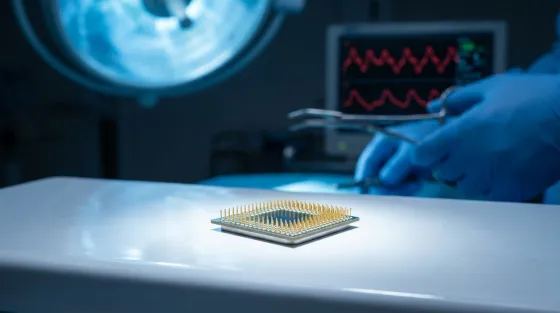
NEO is a coin-sized device that uses 8 electrodes placed on the outer membrane of the brain. Unlike Neuralink's approach, which threads electrodes directly into brain tissue, NEO sits on the surface. It is less invasive, which matters enormously when you are talking about surgery on someone's brain.
The device is designed to help patients with cervical spinal cord injuries regain hand function. It works by reading brain signals, decoding them through software, and sending commands to a pneumatic robotic glove that restores grasping ability. It is not controlling a cursor or playing video games. It is helping paralysed people pick things up again.
Eligibility is specific: patients must be aged 18 to 60, have had their paralysis for at least a year, and their condition must have been stable for a minimum of six months. They also need to retain some upper arm function. In clinical trials, 32 patients received the implant, and all reportedly showed improvement in grasping function.
How Does This Compare to Neuralink?
The obvious comparison is with Neuralink, which has become the poster child for brain-computer interfaces thanks to its high-profile founder and ambitious claims. As of January 2026, Neuralink had enrolled 21 participants in its clinical trials. Its first human participant, Noland Arbaugh, demonstrated impressive digital control, including moving cursors and playing games using only his thoughts.
But here is the crucial difference: Neuralink does not have commercial approval. It holds two FDA Breakthrough Device Designations (one for speech restoration, another for vision restoration), but commercial availability for patients is not expected before 2028 at the earliest. The FDA actually rejected Neuralink's initial clinical trial application in 2022 before approving it the following year.
It is also worth noting these devices serve quite different purposes. Neuralink's current focus is on digital interaction for severely paralysed individuals, while NEO targets physical rehabilitation through the robotic glove. Comparing them directly is a bit like comparing a smartphone to a hearing aid. Both are impressive technology, but they are solving different problems.
China's Bigger Play
What makes this story genuinely significant is not just one approved device. It is the ecosystem China is building around brain-computer interfaces.
In December 2025, at the Shenzhen BCI and Human-Computer Interaction Expo, China announced an 11.6 billion yuan (roughly $165 million) brain science fund. The targets are ambitious: major breakthroughs by 2027, two to three world-class BCI companies by 2030, and a full domestic supply chain by the same date.
China's 2026 to 2030 five-year plan designates BCI as a "future industry" and a national strategic priority. Several provinces, including Sichuan, Hubei, and Zhejiang, have already set medical service pricing for BCI procedures to speed up inclusion in the national medical insurance system. That is not just research funding. That is building an entire commercial infrastructure from the ground up.
Neuracle is not even the only Chinese company making waves. Shanghai NeuroXess implanted a device in a 28-year-old man who had been paralysed for eight years, and he was controlling digital devices within five days. BrainCo and Gestala are also active in the space.
Should the West Be Worried?
Worried might be too strong. Paying attention, absolutely.
The United States and Europe have taken a deliberately cautious approach to BCI regulation, which is entirely understandable when you are dealing with devices that go inside people's skulls. The FDA's initial rejection of Neuralink's trial application shows that rigorous scrutiny is being applied. US competitors like Synchron, Paradromics, and the BrainGate consortium are all progressing through their own research and trial phases, but none have commercial approval either.
China's faster regulatory pathway could be seen as either admirably efficient or concerning, depending on your perspective. The clinical trial data for NEO (32 patients with positive outcomes) is promising, but it is a relatively small sample. Long-term safety and efficacy data will take years to accumulate.
That said, there is a pattern here that feels familiar. China identified electric vehicles as a strategic industry, invested heavily, built the infrastructure, and now dominates global EV production. The playbook for BCIs looks remarkably similar: government funding, regulatory fast-tracking, provincial cooperation on pricing, and explicit targets for global competitiveness.
What This Means for Patients
For people living with spinal cord injuries, the approval of NEO is genuinely exciting news. It represents the first time a brain-computer interface has moved from the realm of experimental research into something a doctor can actually prescribe. The focus on practical rehabilitation rather than digital novelty is refreshing too.
For UK readers, the practical impact is limited for now. NEO is approved for the Chinese market, and there is no indication of when or whether it might seek approval from the MHRA or other international regulators. But it does set a precedent. Once one country demonstrates that commercial BCIs are viable, it creates pressure on regulators elsewhere to establish their own frameworks.
The Verdict
China's approval of the NEO brain implant is a genuine milestone, not just for Chinese technology but for the entire field of brain-computer interfaces. It is the first time any country has said: this is safe enough and effective enough to sell commercially.
Whether China's aggressive approach to dominating the BCI industry will pay off remains to be seen. The technology is still in its early days, the patient population for NEO is specific, and the long-term implications of commercial brain implants raise ethical questions that no country has fully answered yet.
But make no mistake: the race to commercialise brain-computer interfaces is no longer theoretical. China just fired the starting gun, and everyone else is still lacing up their trainers.
Read the original article at source.





No comments yet. Be the first to share your thoughts.