Slow Down, Stay Home, Save Oil: The IEA's Bold Plan to Tackle the Biggest Energy Crisis in History
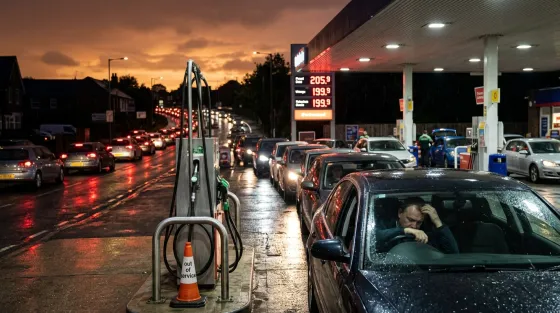
The World's Oil Lifeline Just Got Choked
If you have filled up your car recently and winced at the price, you are not imagining things. Since US and Israeli strikes on Iran began on 28 February 2026, the Strait of Hormuz, the narrow waterway that normally handles roughly 20% of the world's crude oil (around 20 million barrels a day), has been effectively shut down. Where 138 ships used to pass through daily, only about five are now making the journey, largely because insurers have pulled coverage on tankers transiting the area.
The result? Brent crude smashed through the $100 barrier on 8 March and peaked at a stomach-churning $126 per barrel. Oil prices have surged more than 40% since the conflict started. And on 20 March, the International Energy Agency published a 10-point plan that essentially says: if you can work in your pyjamas and drive a bit slower, now would be a really good time to start.
What Exactly Is the IEA Asking Us to Do?
The IEA's recommendations are aimed at governments, businesses, and ordinary households worldwide. The core message is refreshingly blunt: the world cannot simply produce its way out of an oil shock. It must adapt to lower consumption. In other words, drilling more is not going to fix this one. We need to use less.
Here are the headline measures:
- Work from home at least three extra days per week. The IEA reckons this alone could cut national car oil consumption by 2-6%, with individual drivers saving around 20% on their fuel bills. Your boss might finally have a compelling reason beyond "employee wellbeing" to let you skip the commute.
- Reduce highway speed limits by at least 10 km/h (roughly 6 mph for us in the UK). Less dramatic than it sounds, but the maths is persuasive: it could cut vehicle oil consumption by 5-10%. Motorway journeys would take slightly longer, but your wallet would thank you.
- Slash business flights by around 40%. This could reduce jet fuel demand by 7-15%. After the pandemic proved that most meetings genuinely can be an email (or at least a video call), this feels less like a sacrifice and more like common sense.
- Consider switching from gas cookers to electric. This one will raise eyebrows in the UK, where gas hobs are practically a religion in some kitchens. The IEA also suggests reserving LPG supplies for households that genuinely cannot switch.
There are further measures in the full 10-point plan, but the theme is consistent: small, practical changes from millions of people add up to enormous savings when road transport alone accounts for roughly 45% of global oil demand.
Why This Matters More Than Previous Crises
The IEA is not prone to hyperbole. So when it describes the Strait of Hormuz disruption as the largest supply shock in modern history, it is worth paying attention. Senior crude analyst Johannes Rauball of Kpler went further, calling it "the largest disruption to crude supplies in the history of the global oil market."
To put the scale in perspective: on 11 March, IEA member countries agreed to release 400 million barrels from their emergency reserves. That is the largest coordinated release in the agency's 52-year history, more than double the 183 million barrels released after Russia invaded Ukraine in 2022. The United States alone contributed 172 million barrels from its Strategic Petroleum Reserve.
This is only the sixth time the IEA has triggered such an intervention since it was founded in 1974. Previous occasions include the 1991 Gulf War, Hurricane Katrina in 2005, the Libyan civil war in 2011, and the 2022 Ukraine crisis. The fact that this release dwarfs all of them tells you everything about the severity of the situation.
Countries Are Already Acting
While the UK government mulls its options, several countries have already started implementing the IEA's recommendations. The Philippines and Pakistan have introduced four-day government work weeks. Sri Lanka has closed public offices on Wednesdays. Lao PDR, Thailand, and Vietnam are actively promoting remote working.
These are not token gestures. When passenger cars account for approximately 60% of energy use on roads in wealthier economies, getting even a fraction of commuters off the road makes a measurable difference.
The UK Angle: What This Means for Your Wallet
For UK households already feeling the squeeze from years of elevated energy costs, the IEA's advice lands differently than it might in, say, Texas. We are a nation of commuters, many of whom have been dragged back to the office in recent years despite the pandemic proving remote work was perfectly viable.
The 6 mph speed reduction is worth thinking about practically. If you currently cruise at 70 mph on the motorway, dropping to 64 mph is not going to transform your journey time on most routes. But it could meaningfully reduce your fuel consumption at a time when petrol prices are climbing sharply.
The gas cooker question is trickier. Millions of UK homes rely on gas for cooking, and switching to electric is not free or instant. But for those already considering an induction hob, the economic argument just got stronger.
Will It Actually Work?
The IEA suggests that if all 10 measures were fully implemented, global oil demand could fall by an estimated 2.7 million barrels per day within four months, though it should be noted this specific figure has appeared in reports but has not been independently verified against the original IEA document.
Full implementation is, of course, optimistic. But even partial adoption across the IEA's 32 member countries would buy valuable time while the geopolitical situation remains volatile. Some analysts have warned that if the Strait of Hormuz stays effectively closed, oil could reach $200 per barrel, a scenario that would make the current prices look like a bargain.
The Bottom Line
The IEA's message is not complicated: drive less, drive slower, fly less, work from home more, and think about how you cook. None of these are revolutionary ideas. But when the world's most authoritative energy body frames them as essential rather than optional, against the backdrop of the worst oil supply disruption ever recorded, it is probably time to listen.
For UK households watching the forecourt prices tick upward, the good news is that the most impactful changes, working from home and easing off the accelerator, cost nothing to implement. The bad news is that this crisis is not going away quickly, and the reserve releases, however historic, are a bridge, not a solution.
Time to dust off those slippers and rediscover the joys of the home office, then.
Read the original article at source.





No comments yet. Be the first to share your thoughts.