Nairobi is Currently More Water than City and it is No Holiday
A Not So Gentle Drizzle
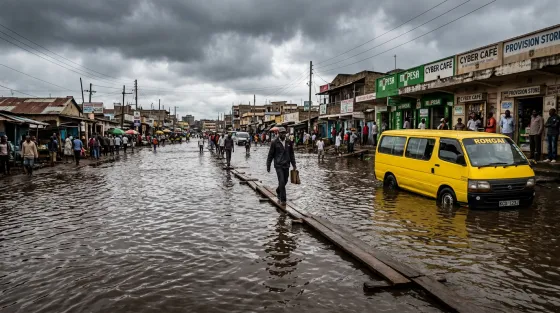
We all love a bit of a moan about the weather in the UK. It is practically our national sport, right up there with queuing and wondering why the trains are delayed because of the wrong kind of leaves. However, what is currently happening in Kenya puts our damp Tuesdays to absolute shame. We are not talking about a bit of localised flooding that ruins your new suede boots. We are talking about a full scale aquatic assault that has claimed 66 lives and left the capital, Nairobi, looking more like a set from an expensive disaster film.
If you thought your morning commute was a bit of a slog because of a signal failure at Clapham Junction, spare a thought for the eleven people who spent their night trapped in a minibus taxi. This was not just a case of getting stuck in a bit of traffic. The vehicle, known locally as a matatu, became an island in the middle of a rising tide in Nairobi. Rescue workers had to scramble in the dark to pull them to safety as the floodwaters threatened to turn their commute into a submarine expedition. It is the sort of thing that makes you appreciate the relative stability of a drizzly walk to the bus stop in Croydon.
The Human Cost of the Deluge
The numbers coming out of the region are genuinely sobering. With 66 people confirmed dead, this is far beyond a seasonal inconvenience. The heavy rains have been relentless, turning roads into rivers and homes into hazards. For those of us sitting comfortably in the UK, it can be hard to grasp the scale of such a catastrophe. While we worry about the price of a pint or the latest hike in our broadband bills, thousands of people in Kenya are facing the literal destruction of their livelihoods. The economic impact on a developing nation when infrastructure is washed away is massive, and it is the kind of thing that has a ripple effect on global markets, including the prices we pay for our morning tea and coffee.
The Kenyan government and various aid agencies are working overtime, but nature is a formidable opponent when she is in this kind of mood. The Red Cross has been on the ground, but even the best prepared teams find it difficult to navigate a city that has effectively been redrawn by water. It is a stark reminder that despite all our technological prowess, we are still very much at the mercy of the elements.
The Tech Behind the Torrent
From a tech perspective, you might wonder why we cannot see this coming with enough precision to avoid the tragedy. We have satellites, we have AI powered weather models, and we have enough data to tell us exactly when it is going to rain on a specific street in Islington. However, the reality on the ground in Kenya is a bit more complicated. Infrastructure for early warning systems requires significant investment, and when you are balancing a national budget, sometimes the long term tech solutions lose out to more immediate needs. This is where the UK economy minded perspective comes in: investing in disaster prevention is always cheaper than cleaning up the mess afterwards, but finding the capital to do so is the perennial challenge.
Social media has played a massive role in the rescue efforts, though. In Nairobi, residents have been using their phones to live stream the flooding, alert emergency services to trapped neighbours, and coordinate volunteer efforts. It is a fascinating, if slightly grim, look at how the smartphone has become the most essential tool in a survival kit. Forget your Swiss Army knife; if you are stuck on the roof of a minibus, you want a full battery and a decent 4G signal.
The El Niño Factor
So, why is this happening now? The experts are pointing their fingers at El Niño. For those who skipped that particular geography lesson, it is a climate pattern that involves the warming of surface waters in the eastern Pacific Ocean. It sounds like something that should stay in the Pacific, but it has a knack for messing with weather systems across the globe. In East Africa, it usually means much heavier rainfall than usual. We are seeing the consequences of a global climate system that is increasingly volatile. It is not just a Kenyan problem; it is a symptom of a planet that is struggling to maintain its balance.
For the average tech enthusiast or lifestyle blogger, this might seem a world away. But consider the supply chains. Our world is interconnected in ways we often forget until something breaks. From agricultural exports to the stability of regional tech hubs, what happens in Nairobi matters in London. We are all part of the same global economy, and when one part of it is underwater, we all feel the dampness eventually.
A Verdict on Preparedness
Is there a silver lining? Perhaps only the resilience of the people on the ground. The rescue of those eleven people from the minibus is a testament to human bravery and the ability to act under pressure. But as a society, we need to be asking why we are still being caught out by predictable climate patterns. The tech exists to mitigate these disasters, but the political and economic will to implement it on a global scale seems to be lagging behind.
If you are looking for a takeaway from this, let it be a bit of perspective. The next time it rains in London and your umbrella blows inside out, just remember that you are not currently sitting on top of a minibus in Nairobi waiting for a boat. We have it pretty good, all things considered. But we should also be looking at how we can support better infrastructure and climate resilience globally, because this kind of news is becoming far too common.
Read the original article at source.



No comments yet. Be the first to share your thoughts.