Falling With Style: Why Your Cat Is Basically A Furry Physics Cheat Code
The Gravity-Defying Mystery of the Common House Cat
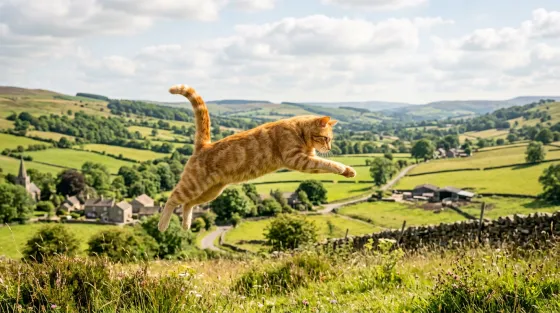
If you have ever had the misfortune of watching your cat misjudge a leap from the kitchen counter, you will know the feeling of pure, unadulterated panic. One moment they are a majestic predator, the next they are a flailing bundle of fur and questionable life choices. Yet, more often than not, they land with the kind of smug grace that suggests they planned the whole thing. It is a phenomenon that has baffled scientists and annoyed clumsy humans for centuries. How is it that a creature with the brain the size of a walnut can master the laws of physics better than a NASA engineer?
A recent study has delved back into this age-old riddle, and the findings are as fascinating as they are humbling. It turns out that the secret to the cat's acrobatic prowess is not just luck or nine lives. It is a masterclass in biological engineering, specifically centred around an incredibly flexible spine and a bit of clever maths that would make a university professor sweat.
The Falling Cat Problem: A Brief History
Believe it or not, the falling cat has been a serious subject of scientific inquiry for a very long time. In the late 19th century, physicists were genuinely stumped. According to the law of conservation of angular momentum, an object that is not rotating cannot suddenly start rotating without pushing off something else. If you drop a cat upside down, it should, in theory, stay upside down until it hits the floor. Yet, as every cat owner knows, they manage to flip themselves over mid-air without having anything to kick against.
James Clerk Maxwell, the Scottish physicist who basically figured out electromagnetism, was famously obsessed with this. He spent an alarming amount of time dropping cats out of windows to see how they did it. Do not worry, the cats were fine, though they probably did not appreciate being used as lab equipment for Victorian science. It was only with the advent of high-speed photography that we finally saw the truth. Cats do not break the laws of physics: they just navigate them with more flair than we do.
The Secret Is in the Twist
The latest research highlights that the primary weapon in a cat's arsenal is its spine. Most mammals have a fairly rigid back structure designed for support. Cats, however, are essentially made of liquid. Their vertebrae are connected with incredibly flexible joints, allowing them to twist their front half in one direction while their back half stays still, or even moves the other way.
When a cat falls, its inner ear immediately tells it which way is up. This is the vestibular apparatus at work, acting like a high-precision gyroscope. Once the cat knows where the floor is, the real magic starts. It tucks its front paws in close to its body to reduce its moment of inertia, allowing the front half of the body to rotate quickly. At the same time, it extends its back legs to increase inertia, which keeps the rear half from rotating too much in the opposite direction. Then, it reverses the process: it tucks the back legs and extends the front ones to bring the rear around. It is a rhythmic, mechanical dance that happens in less than a second.
The Bend and Snap (But for Physics)
The study clarifies that the cat is not just spinning. It is bending its body in the middle. By arching its back and twisting, the cat creates a 'zero-angular-momentum turn'. This is the same principle that allows divers and gymnasts to flip in the air, but cats do it instinctively from the moment they are kittens. They are born with a biological cheat code for gravity.
Why This Matters for Technology
You might be wondering why we are still studying falling cats when we have things like the cost of living crisis and climate change to worry about. The answer lies in robotics and space exploration. Engineers are constantly looking for ways to make robots more agile. If we can build a robot that mimics the feline spine, we can create machines that can survive falls or navigate treacherous terrain without toppling over like a cheap tent.
In space, where there is no gravity to tell you which way is up, the cat's method of turning without pushing off a surface is incredibly useful. Astronauts have actually studied cat videos to learn how to reorient themselves in zero-G. It turns out that Mittens is a better astronaut than most of us.
The Verdict: A Masterpiece of Evolution
So, what have we learned? Firstly, cats are far more complex than their penchant for chasing laser pointers would suggest. Their ability to land on their feet is a testament to millions of years of evolutionary refinement. They are built for survival in a way that makes the average human look like a bag of wet flour by comparison.
However, it is important to remember that cats are not invincible. While they are brilliant at landing, 'High-Rise Syndrome' is a real danger. The study notes that while cats can survive falls from impressive heights, they still face risks of injury. They are good, but they are not magical. If you live in a flat, keep your windows secure. Your cat might be a physics genius, but even Einstein probably would not have enjoyed falling from the fourth floor.
Pros of Cat Physics
- Near-perfect landing record from moderate heights.
- Incredible spinal flexibility that puts yoga instructors to shame.
- Natural gyroscopic sensors that never need recalibrating.
- Zero-angular-momentum movement that defies basic intuition.
Cons of Cat Physics
- Can lead to overconfidence (the 'I meant to do that' look).
- Not effective against very low falls where there is no time to flip.
- Does not protect against the indignity of falling off a sofa while asleep.
The Final Word
The next time you see your cat perform a mid-air correction after a botched jump, take a moment to appreciate the sheer mechanical brilliance on display. They are not just pets: they are highly sophisticated biological machines that treat the laws of physics as mere suggestions. We might pay the mortgage, but they have mastered the universe. It seems like a fair trade.
Read the original article at source.



No comments yet. Be the first to share your thoughts.