From Energy Chaos to Coastal Calm: Friday's Papers Capture a World in Contrast
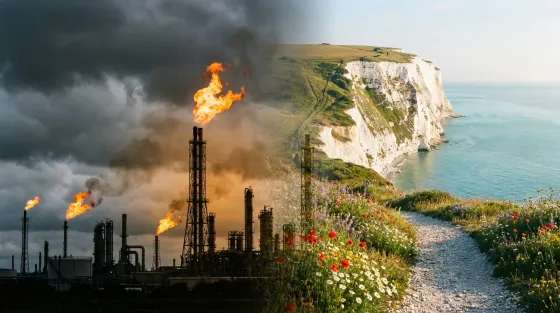
A Tale of Two Headlines
Friday's front pages served up a study in contrasts so stark you could get whiplash flipping between them. On one side: a genuine global energy crisis unfolding in the Middle East, with oil prices doing their best impression of a rocket launch. On the other: the King strolling along a lovely new coastal path in East Sussex. If that does not sum up the peculiar duality of British news consumption, nothing does.
The Energy Shock Nobody Wanted
Let us start with the less pleasant headline. The escalating conflict between Iran and Israel has taken a dramatic and deeply consequential turn towards the world's energy infrastructure, and the fallout is already hitting wallets from London to Lagos.
The sequence of events reads like a geopolitical thriller with an uncomfortably real price tag. After Israeli strikes targeted Iran's South Pars gas field, the largest natural gas field on the planet, Iran responded by hitting energy infrastructure across the Gulf. Most critically, the strikes knocked out 17% of Qatar's liquefied natural gas export capacity at the Ras Laffan facility.
Now, 17% might not sound catastrophic in isolation. But when you consider that Qatar supplies roughly 20% of the world's LNG, that single attack just punched a significant hole in global energy supply. The damage to Ras Laffan alone is estimated to cost $20 billion in annual lost revenue, and repairs could take up to five years. That is not a quick fix with some duct tape and optimism.
Oil Prices: Going Up Like a Lift With No Buttons
The oil markets have responded with predictable panic. Brent crude briefly touched $119 a barrel on 19 March, a figure that would have seemed almost quaint during the relatively calm days of early 2026. Since the conflict kicked off on 28 February, oil prices have surged from around $70 to well over $110 per barrel. For those keeping score at home, that is roughly a 60% increase in under three weeks.
Making matters worse, the Strait of Hormuz, that narrow but enormously important waterway through which approximately 20% of global oil supplies flow, is now largely blocked. Think of it as the M25 of international energy logistics, except when this one jams up, entire economies start sweating.
What Is Being Done About It?
The International Energy Agency has agreed to release a record 400 million barrels of oil from strategic reserves, a move announced on 11 March that was meant to calm markets. It has helped a bit, in the same way that putting a plaster on a broken leg helps a bit. Meanwhile, the Pentagon has requested an additional $200 billion in war funding, a number so large it almost loses meaning.
Energy analysts are calling this the worst disruption since the 1970s oil crisis, and for once, the hyperbole might actually be justified. Europe's gas benchmark surged around 6% as traders scrambled to price in what a prolonged Gulf energy disruption would mean for a continent that was already feeling bruised from years of volatile energy costs.
What This Means for UK Households
For those of us in Britain, the implications are depressingly straightforward. Higher oil and gas prices feed directly into energy bills, fuel costs, and the price of basically everything that needs to be transported, which is basically everything. Just when we thought the cost of living crisis might be easing, the Middle East has handed us a fresh reminder that global energy markets do not care about your household budget.
If you have been putting off fixing your home insulation or considering an electric vehicle, this might be the nudge you did not want but probably needed. Energy independence, even at a personal level, has never looked more appealing.
And Now for Something Completely Different: The King Takes a Walk
In what might be the most perfectly timed bit of positive news imaginable, the other major story dominating Friday's papers is considerably more wholesome. King Charles III officially inaugurated the England Coast Path, now formally named the King Charles III England Coast Path, on 19 March.
Stretching an impressive 2,689 miles around the entire English coastline, it is officially the world's longest managed coastal walking route. Let that sink in for a moment. We might be rubbish at keeping energy prices down, but we have absolutely nailed the long walk along a beach.
Sixteen Years in the Making
The path has been a proper labour of love. The project began back in 2010 and has taken approximately 16 years to complete, spanning no fewer than seven prime ministers. It has created around 1,000 miles of entirely new legal coastal access, opening up stretches of shoreline that were previously off-limits to the public.
The budget tells its own very British story: initially set at £25 million, the final projected cost came in at £28 million. By government project standards, coming in only £3 million over budget after 16 years is practically a miracle. Someone deserves a quiet round of applause for that.
At launch, over 2,000 miles of the path are fully open and ready for boots, with 556 miles still being worked on and 78 miles awaiting final decisions. So it is not quite the full loop yet, but it is close enough to start planning some seriously ambitious weekends.
The Royal Seal of Approval
King Charles walked a 2km stretch of the path accompanied by Tony Juniper, Chair of Natural England, before heading to open the new Seven Sisters National Nature Reserve in East Sussex. Given Charles's well-documented love of the outdoors and environmental causes, this was clearly a gig he was genuinely chuffed about rather than one of those ribbon-cutting duties that monarchs endure with politely fixed smiles.
The path was renamed from the rather plain 'England Coast Path' to the 'King Charles III England Coast Path' in 2024 to mark the coronation, which feels like a fitting tribute. After all, if you are going to name the world's longest coastal walk after someone, it might as well be a king who actually enjoys a good ramble.
Two Stories, One Friday
There is something oddly poetic about these two stories sitting side by side on the front pages. One represents the terrifying fragility of our globalised energy systems and the very real human cost of conflict. The other represents something quieter but arguably just as important: the slow, patient work of making our own corner of the world a bit more accessible and beautiful.
The energy crisis will dominate headlines for weeks, possibly months, and its economic consequences will be felt in every British household. But when the dust settles and the tanks are refilled at whatever eye-watering price the market settles on, the coast path will still be there. All 2,689 miles of it, waiting for anyone with a decent pair of walking boots and a flask of tea.
Sometimes the best response to global chaos is to lace up your shoes and go for a very, very long walk.
Read the original article at source.




No comments yet. Be the first to share your thoughts.