China’s Grand Prix Chaos: Why F1’s Big Three Prove the Sport is Having a Mid-Life Crisis
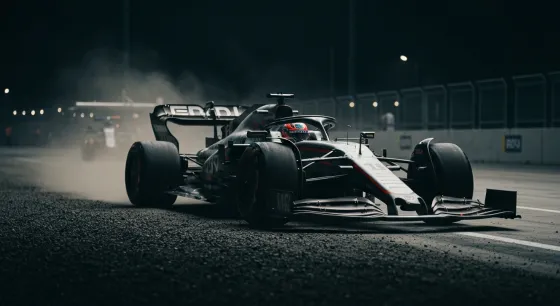
The Great Wall of Speed and the Return to Shanghai
It has been five long years since Formula 1 last graced the Shanghai International Circuit. Five years. In that time, the world has changed, the cars have grown floor-effect wings, and most of us have aged about a decade in stress alone. Returning to China felt like visiting an old school friend only to find they have had a massive amount of work done. The track surface was weirdly painted, the bumps were more aggressive than a London commute, and the fans were quite rightly losing their minds over the first home-grown hero, Zhou Guanyu.
But as the dust settled over the weekend, three names stood out like a sore thumb. Lewis Hamilton, Fernando Alonso, and Max Verstappen. These three blokes represent the past, present, and terrifyingly efficient future of the sport. Their performance in China perfectly captured the ongoing tug-of-war between F1 as a serious technical pursuit and F1 as a high-octane soap opera designed to keep people scrolling on TikTok.
The Verstappen Vacuum: Brilliant or Boring?
Let us start with the man who is currently making the rest of the grid look like they are driving milk floats. Max Verstappen is a phenomenon. There is no other way to put it. His victory in China was so clinical it felt like watching a surgeon perform a routine operation. He did not just win: he dominated. For the purists, this is peak F1. It is the perfect marriage of a generational talent and a car that seems to defy the laws of physics. If you appreciate the technical side of the sport, Verstappen is a masterpiece.
However, for the average viewer who has just shelled out a small fortune for a Sky Sports subscription, there is a problem. Verstappen is so good that he is actually making the sport a bit of a snooze-fest at the front. He is currently in a league of his own, and while his skill is undeniable, the lack of a genuine fight for the lead is a bit of a damp squib. We want to see wheel-to-wheel action, not a 20-second lead by lap ten. It is the ultimate paradox: we want the best to win, but we would quite like it if they struggled a bit more while doing it.
Fernando Alonso: The King of Chaos
If Verstappen is the clinical surgeon, Fernando Alonso is the bloke at the pub who starts a fight just to see what happens. At 42 years of age, Alonso is still driving with the hunger of a teenager who has just discovered caffeine. His performance in the Sprint and the main race was a masterclass in how to be a nuisance. He knows his Aston Martin is not quite as fast as the Ferraris or the Red Bulls, so he uses his brain instead.
Alonso’s defensive driving is a work of art. He knows exactly where to place his car to make overtaking impossible, and he is not afraid to get his elbows out. Watching him scrap with Carlos Sainz and Sergio Perez was easily the highlight of the weekend. He represents the soul of F1: the grit, the determination, and the sheer wiliness of a veteran who knows every trick in the book. He is proof that while the tech is important, the person behind the wheel still matters. In a sport that is increasingly dominated by data and simulations, Alonso is a glorious, petrol-scented anomaly.
The Hamilton Rollercoaster
Then we have Lewis Hamilton. Our seven-time champion had a weekend that can only be described as a proper emotional rollercoaster. One minute he was finishing second in the Sprint race, looking like the Lewis of old and giving us all a glimmer of hope. The next, he was knocked out in Q1 and complaining that his car was practically undriveable. It was a stark reminder of how far Mercedes have fallen and how much the sport relies on the machinery.
Hamilton’s struggle is a difficult watch for UK fans. We are used to seeing him at the sharp end, but currently, he is fighting for scraps in the midfield. Yet, even on his worst days, Hamilton brings a level of star power that the sport desperately needs. He is more than just a driver: he is a global icon. His presence on the grid adds a layer of prestige that even Verstappen’s trophies cannot quite match. The conflict here is clear: F1 needs its biggest stars to be competitive, but the current technical regulations have left one of the greatest of all time languishing in the pack.
The Sprint Format: A Solution Looking for a Problem?
We cannot talk about the Chinese Grand Prix without mentioning the Sprint format. F1 is obsessed with adding more value for money, which in theory is a great idea. We want more racing, right? Well, yes and no. The Sprint in China was actually quite entertaining, mostly thanks to a bit of rain in qualifying and Alonso being Alonso. But there is a nagging feeling that we are overcomplicating things.
The constant tweaking of the weekend schedule feels a bit desperate. It is as if the powers that be are worried that a standard race weekend is too boring for the modern audience. By trying to make every single session high-stakes, they risk devaluing the main event on Sunday. There is something to be said for the slow build-up of a traditional GP weekend. Sometimes, less is more. But in the world of Netflix and 24/7 social media, "less" is a dirty word.
The Verdict: A Sport at a Crossroads
So, where does this leave us? The Chinese Grand Prix was a fantastic spectacle, but it also highlighted the identity crisis at the heart of F1. On one hand, you have the technical perfection of Red Bull and Verstappen, which is impressive but often predictable. On the other, you have the human drama provided by legends like Alonso and Hamilton, which is what actually keeps us glued to the screen.
The sport is currently trying to be everything to everyone. It wants to be a pinnacle of engineering, a global entertainment brand, and a sustainable, forward-thinking business. Balancing these things is nearly impossible. For the UK fan, who is often watching through bleary eyes at 8 am on a Sunday, the priority is simple: we want to see the best drivers in the world actually racing each other.
The Chinese GP showed that F1 is still capable of being brilliant, but it also showed that it can be its own worst enemy. We do not need gimmicks or constant rule changes. We just need a grid where more than one person has a realistic chance of winning. Until that happens, we will have to rely on the likes of Alonso to keep us entertained while Verstappen disappears into the distance.
Read the original article at source.



No comments yet. Be the first to share your thoughts.