Boots or Trail Runners for Hiking? The Great Footwear Debate Settled (2026)
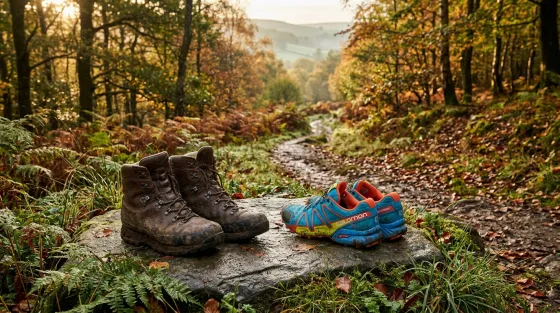
The Walking Boot Is Having an Identity Crisis
There was a time when heading into the hills meant lacing up a pair of ankle-high leather boots that weighed roughly the same as a small dog. Those days are, for most hikers at least, well and truly over. Trail runners have staged a quiet revolution on our footpaths, and the numbers tell the story rather convincingly.
According to The Trek's 2025 Appalachian Trail Thru-Hiker Survey, a whopping 77% of thru-hikers set off in trail runners, and 87% wore them for the majority of their hike. Over half rated their trail runner choice a perfect 10 out of 10. That is not a niche trend. That is a landslide.
So should you bin your boots entirely? Not necessarily. But you should probably hear the case for both sides before your next trip to the Lake District.
The Case for Trail Runners
The headline advantage is weight. A typical pair of hiking boots tips the scales at over 2 pounds (often closer to 3), while trail runners come in at roughly 18 to 25 ounces per pair. That difference matters more than you might think. An often-cited (though hard to pin down) 1984 military study suggested that a pound on your feet is equivalent to roughly five on your back in terms of energy expenditure. Whether the exact ratio holds up to modern scrutiny, the principle is sound: lighter feet mean less fatigue.
Then there is breathability. Trail runners let your feet breathe, which means fewer blisters and happier toes on long days. They also dry out far quicker after an inevitable bog crossing, something any British hiker will appreciate roughly eleven months of the year.
The other big selling point is comfort straight out of the box. No break-in period, no plasters on your heels for the first fortnight. Brands like Hoka, Salomon, and Altra (whose Lone Peak remains the single most popular shoe among AT thru-hikers) have made trail runners that genuinely handle rough terrain.
The Case for Boots
Boots still earn their keep in specific situations. If you are carrying a heavy pack (think multi-day wild camping with 15kg on your back), the added ankle support and stiffer sole of a proper boot help manage that load across uneven ground. Technical scrambles in Snowdonia or the Scottish Highlands also favour something more robust underfoot.
Durability is the other factor. Trail runners last approximately 500 miles before they need replacing, whereas a decent pair of hiking boots will manage 800 to 1,000 miles or more. If you are not hiking huge distances each year, boots may actually work out cheaper over time, despite a higher upfront cost (roughly £120 to £200 for boots versus £80 to £130 for trail runners at UK retail).
For anyone with dodgy ankles or recovering from an injury, the higher cut of a boot provides genuine reassurance, even if the evidence on whether low-cut shoes actually build ankle strength remains inconclusive.
So Which Should You Choose?
Here is a rough decision framework:
- Day hikes and light loads: Trail runners, almost every time. You will be faster, more comfortable, and less knackered at the end.
- Multi-day backpacking with heavy gear: Boots still make sense, particularly on rocky or technical terrain.
- Wet UK conditions year-round: Trail runners actually handle this surprisingly well. They get wet, but they dry fast. Waterproof boots eventually get wet too, and then stay wet for days.
- Winter and ice: Boots, ideally with crampon compatibility. This is non-negotiable.
The Verdict
For the majority of hikers tackling British hills and trails, trail runners are the smarter choice in 2026. They are lighter, more comfortable, and perfectly capable of handling most conditions you will encounter. The data from long-distance hikers backs this up overwhelmingly.
That said, boots are not obsolete. They remain the right tool for heavy loads, winter conditions, and serious scrambling. The real answer, boringly enough, is that most keen hikers will end up owning both.
Just do yourself a favour and try before you buy. Your feet will thank you around mile three.
Read the original article at source.





No comments yet. Be the first to share your thoughts.