Takaichi Walks a Diplomatic Tightrope as Trump Pushes Japan on Strait of Hormuz
When Your Most Important Ally Starts Making Demands
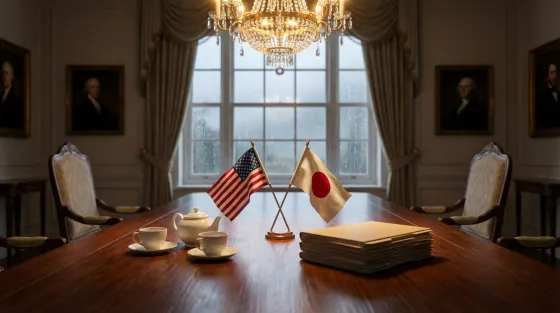
If you have ever been cornered at a dinner party by someone who wants a favour and will not take a hint, you have a rough idea of what Japanese Prime Minister Sanae Takaichi experienced at the White House this week. President Donald Trump, never one for diplomatic subtlety, used a joint press appearance to publicly press Japan on its role in securing the Strait of Hormuz, and the resulting exchange was about as comfortable as a job interview conducted on live television.
Takaichi, for her part, tried to reaffirm the strength of the US-Japan alliance. But reaffirming an alliance while your counterpart is essentially asking you to do more heavy lifting is a bit like telling your partner everything is fine while they are rearranging your furniture without asking.
Why the Strait of Hormuz Matters to Everyone
For those who have not spent their evenings poring over maritime chokepoint maps (and honestly, why not?), the Strait of Hormuz is one of the most strategically significant waterways on the planet. Roughly a fifth of the world's oil supply passes through this narrow channel between Iran and Oman on any given day. When tensions flare in the region, energy markets get nervous, and when energy markets get nervous, everyone from fuel companies to consumers filling up at their local petrol station feels the pinch.
Japan has a particularly acute interest here. The country imports the vast majority of its energy, and a significant chunk of its oil and liquefied natural gas transits through the Strait of Hormuz. Any disruption to that flow would hit Japan's economy like a freight train, which is precisely why Trump sees an opportunity to get Tokyo more involved in regional security operations.
The UK Angle
Britons might be tempted to view this as a distant squabble between Washington and Tokyo, but the ripple effects are very real. Any instability in the Strait of Hormuz sends global oil prices skyward, and that feeds directly into the cost of living over here. Petrol prices, energy bills, the price of anything that needs transporting: it all gets more expensive. For a country already watching every penny at the supermarket checkout, further energy price shocks are about as welcome as a wasp at a picnic.
The Press Conference That Said Everything
The White House press appearance was, by most accounts, a masterclass in diplomatic tension poorly disguised as unity. Reporters noted visible discomfort as Trump steered questions towards Japan's commitments in the Middle East, particularly regarding Iran and the broader security picture around the Strait of Hormuz.
Takaichi attempted to strike a balance. She emphasised the longstanding partnership between the two nations, reiterated Japan's commitment to international stability, and generally did her best to sound supportive without writing any blank cheques. It was a tightrope act, and while she did not fall off, she certainly wobbled.
Trump, characteristically, was more direct. His messaging boiled down to a familiar refrain: allies need to contribute more. It is a line he has used with NATO members, with South Korea, and now, with renewed vigour, with Japan. The subtext was clear enough for anyone paying attention: if you benefit from the security architecture, you need to help pay for it.
What Trump Actually Wants
The specifics of what the US is asking Japan to do remain somewhat fluid, which is itself part of the problem. There has been talk of expanded naval patrols, greater logistical support, and increased intelligence sharing in the region. Japan's Self-Defence Forces have already had a limited presence in the area, but what Trump appears to want goes considerably further.
The challenge for Takaichi is that Japan's post-war constitution places significant constraints on military activity abroad. While recent years have seen a gradual loosening of these restrictions, any substantial escalation of Japan's role in Middle Eastern security operations would be politically contentious at home. Japanese public opinion on overseas military commitments remains cautious, and Takaichi has her own domestic audience to manage.
Iran Looms Large
Underlying all of this is the broader question of Iran. Trump's approach to Tehran has been confrontational, and the situation in the Middle East remains volatile. Japan has historically maintained a more nuanced relationship with Iran, including energy trade ties, which makes its position in any US-led pressure campaign inherently complicated.
Asking Japan to line up behind a hardline stance on Iran is not just a military question. It is a diplomatic, economic, and constitutional one. Takaichi knows this, which is why her responses at the press conference were carefully calibrated to express solidarity without committing to anything that could blow up domestically.
The Alliance Under Strain?
It would be premature to suggest the US-Japan alliance is in crisis. It remains one of the most important bilateral relationships in the world, underpinned by decades of cooperation, shared security interests, and enormous trade ties. But alliances, like any relationship, can be tested by one party feeling taken for granted and the other feeling pressured into doing things they are not comfortable with.
Trump's transactional approach to alliances is well documented. He views partnerships through the lens of who is contributing what, and Japan's enormous trade surplus with the US has long been a sore point. The Strait of Hormuz issue gives Trump additional leverage: help us with security in a region that directly affects your energy supply, or face questions about the value of the alliance itself.
For Takaichi, the task is to give enough to keep Washington satisfied without overstepping the boundaries that Japanese domestic politics imposes. It is a delicate game, and the stakes are genuinely high. Get it wrong, and she risks either alienating her most powerful ally or triggering a political backlash at home.
What Happens Next
Expect more meetings, more carefully worded statements, and a lot of diplomatic choreography in the coming weeks. Japan will almost certainly offer some expanded role in the region, but the details will be negotiated behind closed doors rather than at press conferences. Both sides have an interest in presenting a united front, even if the reality behind the scenes is rather more fractious.
For the rest of us, the practical takeaway is straightforward. The Strait of Hormuz remains a flashpoint, and how the world's major economies manage security in the region will have real consequences for energy prices and economic stability. Whether you are in Tokyo, Washington, or Tunbridge Wells, the price at the pump is connected to the politics playing out in that narrow stretch of water.
Takaichi will return to Japan with a full inbox and some difficult decisions to make. Trump will continue pushing allies to do more. And the Strait of Hormuz will carry on being the most important waterway most people have never thought about.
Read the original article at source.





No comments yet. Be the first to share your thoughts.