DLSS 5: Nvidia's AI Graphics Revolution That Nobody Actually Asked For
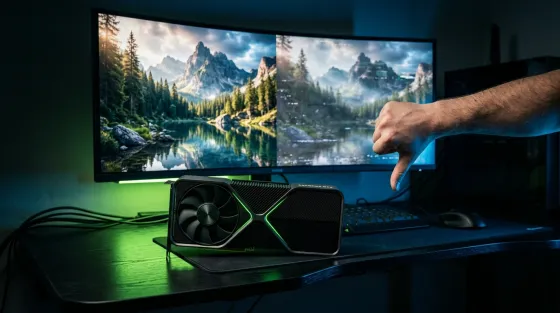
Nvidia has managed something genuinely impressive with DLSS 5. Not the technology itself, mind you, but the sheer scale of the backlash. When your big reveal trailer pulls a 16.3% positive rating on YouTube, with 82,515 dislikes burying 16,107 likes across over a million views, you have not launched a product. You have launched a controversy.
What Is DLSS 5, and Why Is Everyone Cross About It?
Announced at GTC 2026 in March, DLSS 5 marks Nvidia's shift from traditional AI upscaling to full-blown generative AI rendering. Rather than simply sharpening a lower-resolution image, the new system takes a game's colour data and motion vectors, then uses AI to reconstruct scenes with what Nvidia calls 'photoreal lighting and materials.' Jensen Huang described it as 'content-control generative AI' and the most significant graphics breakthrough since real-time ray tracing in 2018.
The problem? It does not just enhance what artists created. It replaces it.
The Numbers Tell a Brutal Story
Every single game demo Nvidia showcased got hammered by viewers. The Resident Evil Requiem demo managed just 14.9% positive ratings. EA Sports FC fared even worse at 14.5%. Hogwarts Legacy and Starfield scraped 18.7% and 18.2% respectively. The only demo to avoid a total mauling was the Zorah Unreal Engine tech demo at 37% positive, which rather proves the point: people are not angry about AI rendering as a concept. They are angry about AI overwriting the art direction of games they already love.
And the visual evidence backs them up. In Resident Evil Requiem, character Grace Ashcroft appears as, according to Digital Foundry's Alex Battaglia, 'a completely different person with different facial features.' Developer SolidPlasma highlighted that DLSS 5 'whitewashes' character features. In the Hogwarts Legacy footage, a 15-year-old character was visibly aged up to look like an adult. These are not subtle enhancements. These are fundamental alterations.
Jensen Says You Are 'Completely Wrong'
When Tom's Hardware put the backlash to Huang directly at a GTC press Q&A, his response was characteristically blunt: 'Well, first of all, they're completely wrong.' He insisted developers have full control to 'fine-tune the generative AI' using tools for intensity, colour grading, and masking.
There is just one small problem with that reassurance.
The Developers Were Not Even Told
Studios featured in Nvidia's own showcase had no idea DLSS 5 was being demonstrated with their games. A Ubisoft developer stated plainly: 'We found out at the same time as the public.' Insider Gaming confirmed the same was true at Capcom. It is rather difficult to claim developers have artistic control when you have not bothered to loop them in.
Named developers from Respawn, Doinksoft, and former Rockstar staff who worked on Red Dead Redemption 2, along with indie creators behind titles like Dusk, Iron Lung, Nuclear Throne, and Ridiculous Fishing, have all spoken out against the technology.
Todd Howard initially praised DLSS 5 running in Starfield, saying it was 'amazing how it brought it to life,' though Bethesda reportedly backtracked on that enthusiasm shortly after.
Even the Tech Press Got Burned
Digital Foundry faced a wave of hostility, including death threats, over their initially positive coverage. Richard Leadbetter admitted 'we should have taken more time,' and Battaglia later reversed course entirely, calling out DLSS 5 for 'trampling on artistic vision in a very hardcore way.' He also noted that despite Huang's claim the tech works 'at the geometry level,' it actually only accesses 2D data like motion vectors, not 3D model information. That is a rather significant distinction Nvidia glossed over.
The UK Value Question
DLSS 5 is set to arrive in autumn 2026, and it will require Nvidia hardware. For UK buyers already paying 15-20% more than US prices for GPUs, the value proposition of a hardware-locked feature that overwrites game art rather than enhancing it is, shall we say, questionable. You are being asked to pay a premium for technology that makes games look different, not necessarily better, and that the people who actually made those games did not approve.
The Verdict
Nvidia may well be right that generative AI rendering becomes the default in a few years. But DLSS 5 in its current form has a trust problem that no amount of keynote bravado can fix. When both your customers and your developer partners are telling you something has gone wrong, responding with 'you are completely wrong' is not confidence. It is arrogance. The technology needs to serve the artists who build these worlds, not override them. Until Nvidia grasps that distinction, DLSS 5 deserves every last one of those dislikes.
Read the original article at source.





No comments yet. Be the first to share your thoughts.